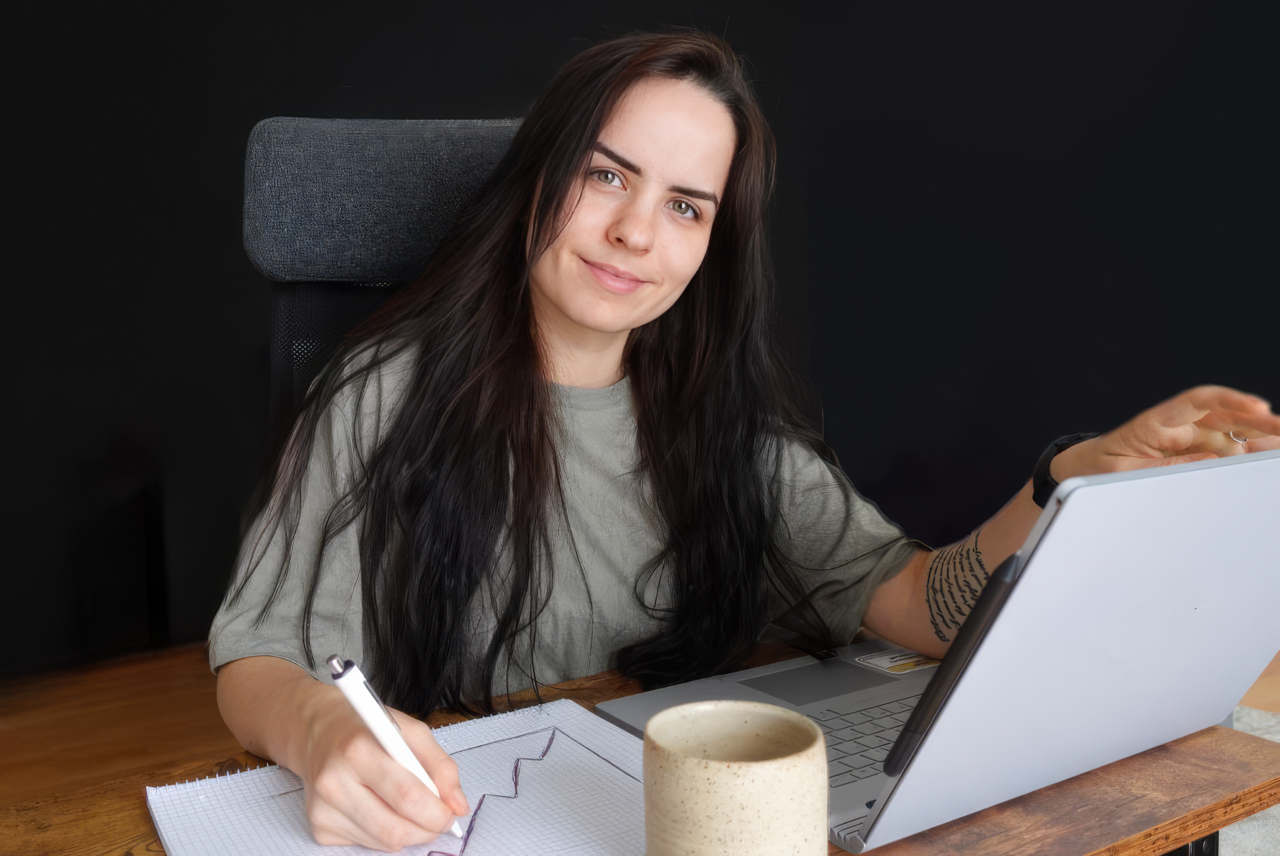
Part of The Deep Dive, a series of interviews with people on work, life and mental health. A conversation with ADHD coach and founder of ADHD University, Coach Antonia, on neurodivergence, creativity, curiosity and living intentionally.
Sometimes the algorithm really knows what it’s doing.
As hard as I try, I cannot sit still. I often sit criss-cross applesauce, and only for a few minutes before I feel the impulse to sit in some other contorted, unnatural position. My cats have given up on making me the primary lap to sit on because I’m just too wiggly. All of this, understandably, has led to some tension in my neck and back.
My 2026 new year’s resolution this year was to take better care of my back. I’ve continuously taken steps to consciously treat my back better — I got a really comfortable Purple mattress, a cool V-shaped pillow to protect my neck when I flip in all directions as I sleep, and a standing desk.
But the problem persists — I still can’t sit properly. Somewhere along the line I typed “ADHD chair” into Google and found out about criss-cross chairs, and went down a rabbit hole.
It led me to a 10-minute YouTube video of ADHD Coach Antonia’s top 10 favorite ADHD products, where she reviewed a really cute looking chair. Her warmth and enthusiasm resonated with me immediately, and I quickly followed her channel, @AntoniasUniverse, on YouTube.
Antonia is an ADHD coach and founder of ADHD University. She speaks openly about her day-to-day experiences living with ADHD, including her experiences with medication, diagnosis, and how she makes life a little bit more ADHD-friendly. She’s tried out systems, reviewed resources, and called out misinformation — leading always with support, clear guidance and encouragement.
So when I found out she started offering weekly body doubling sessions a couple months ago, I knew I wanted to join.
Antonia is just as warm and enthusiastic “in person” as she is in her videos (she is based in Bulgaria, and I am based in Los Angeles). I look forward to our body doubling sessions every week, and I’ve been fortunate to meet other very cool ADHDers from around the world. Together, we tackle the projects and tasks that we have trouble starting and encourage each other to take those first steps together.
I’ve also found in her a kindred spirit — she told me about the VIA Character Strengths, and that you typically share your top strengths with the people you connect with the most. We learned quickly that we both have creativity and curiosity as our top two, so it makes sense that we connected so quickly and so well, even thousands of miles away. She has been immeasurably helpful in providing insight as an expert in neurodivergence, and even more in being a good friend.
I hope you enjoy this conversation with my friend and fellow ADHDer, Antonia. (And all of this reminds me, I still have to get that chair!)
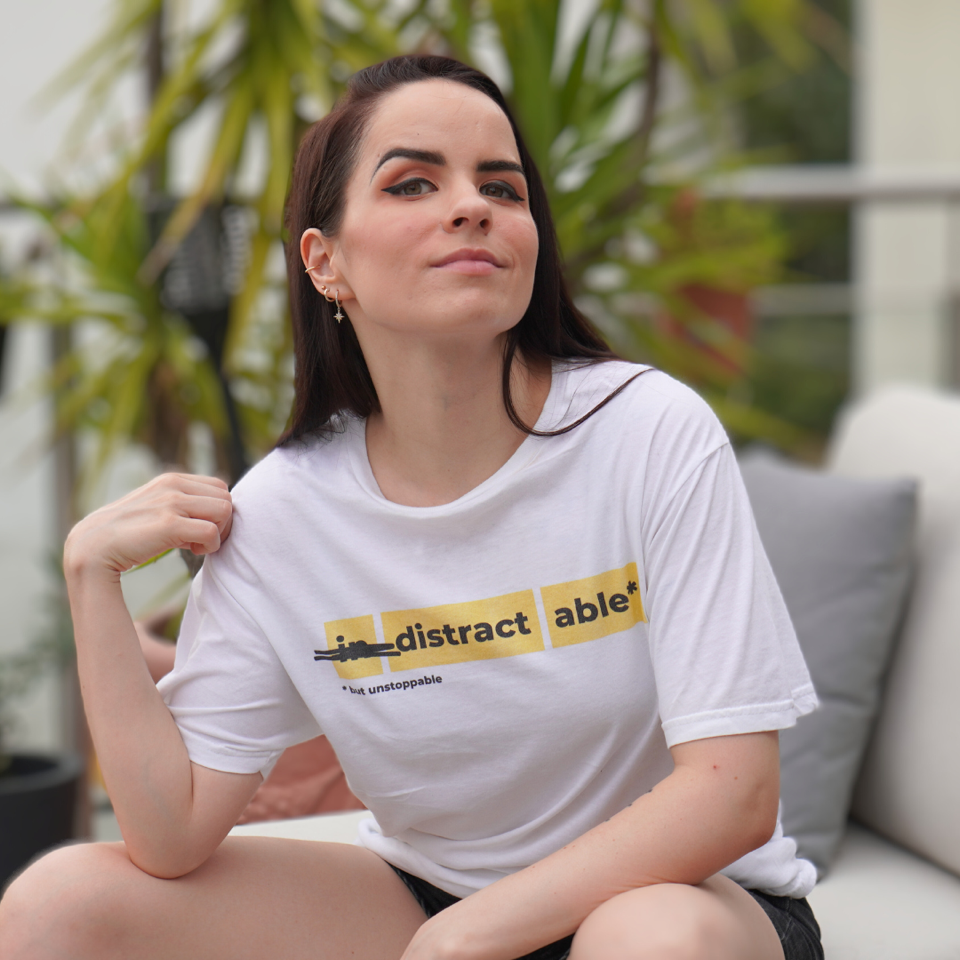
Tell me about yourself. Who are you, and how do you describe what you do?
I love that you asked "who are you," because I really don't vibe with the "what do you do" way of introducing yourself. But to get that out of the way: I'm Antonia, an ADHD coach, educator, and content creator. I've been doing that for six or seven years — sharing what I've learned about ADHD, what helps me, and hopefully letting it help other people in their own lives.
To describe who I am, though, I've learned to use VIA Character Strengths, which [I] use in coaching. So — who am I? I'm a very creative and curious person who has a lot of love to give to the world, and who really appreciates beautiful things and honesty. Those are the strengths that help me research ADHD and create content, but also genuinely empathize with the people I work with.
You live with ADHD and have been very open about your own ADHD diagnosis story. How did the diagnosis process look for you?
I'd almost finished university without a diagnosis. I tried everything, and it was still hard — I was in the library ten hours a day, rewriting entire books just to remember things. At some point I made a list of everything I didn't like about myself that I wanted to fix, and put it into Google. That's when ADHD came up — I wasn't looking for it on TikTok or anywhere like that, I was just genuinely trying to solve the list.
I brought the top symptoms to my [general practitioner], and she said I had anxiety and depression, or maybe an iron deficiency. It took several months of pushing to get referred to an ADHD specialist. He interviewed my partner and my mom, had me fill out childhood-history forms, and eventually said I was a textbook case. That was a huge relief — but then I still had to find someone else to prescribe medication, which took another year of calling people and getting rejected. In Germany, I called around fifty providers. It's a strange system — you need a lot of executive function just to get the medication that gives you executive function. A lot of people probably don't make it through that. I nearly gave up myself, and had someone who'd already gotten medication talk me through sticking with it. I'm glad I did, but it wasn't easy.
I really appreciate your focus on intentional living, particularly your videos where you discuss making the choice to transition out of web development work. What led you to make that decision?
My life was originally headed toward programming — I got a Bachelor of Science in Computer Science and worked in web development for a few years. I did find ways to express creativity, curiosity, and an appreciation for beauty in that work, and I think that's what kept me going, even though it wasn't always easy. But eventually the practical difficulties of ADHD started stacking up — sitting for ten hours working on one problem, not being able to change tasks or choose the task, often not even being able to change how you approach it. There's just this one problem that needs one specific solution. I'd come home with massive brain fog and not be able to do anything else with my day. My work was really fighting against how my brain naturally wanted to work.
There can be a degree of freedom in it, especially [with] freelancing. If a client says "make my website," you get to make the whole thing, and that's creative — you decide everything. But if you're working at a big company, fifty other people have already built the thing and you’re just maintaining it…there’s not much room. You can carve out your own space, but there are still a lot of ADHD logistical struggles in that work. There's a whole ADHD-programmers subreddit, and it's not small — a lot of people struggling with it.
Eminem [saying] "you can do anything you set your mind to" really inspired me to go to university. My ADHD-coach take on that now is: yes, you can do anything you set your mind to, a hundred percent — but what's it going to cost you? And is that cost payable?
[When] I started making ADHD content…it gave me so much passion and satisfaction. Eventually I thought, I need to follow that and pursue it full-time. I didn't want to look back on my life and regret never giving it a proper chance.
What made you decide to build your YouTube content around your own ADHD experience?
[I had a YouTube] channel that was just minimalism and self-improvement content, [and] I was struggling with it because I felt different from other creators in that space — a bit more chaotic, and I like to share things differently than they do. I got lucky and won a coaching session with a creativity coach who'd worked with big bands — someone way out of my normal budget. I went in and said, I want my channel to be really good, but I'm not like other minimalism and self-improvement creators, what do I do?
He said: the issue is you're different because of your ADHD, and you understand your ADHD, but you're still treating it like a problem. I asked, what if your biggest problem is actually the solution? And he said — why are you fighting this really interesting thing about you, that not everyone has, that's genuinely special, that you could be talking about? There are people who will appreciate who you really are, and talking about that. That changed my life. "Is the problem the solution?" is a question I still ask myself.
That's how my ADHD channel was born. I want people to look at what they think is their biggest shortcoming and see how special it can actually be — how it might be their biggest asset, just not looked at in the way that would serve them most.
How did you get into ADHD coaching?
I didn't know I wanted to coach [initially] — I just shared things that helped me. But people it helped started asking, “can you help me implement this?” And I thought, that sounds so exciting and fun — it activated my creativity and curiosity right away. That's when I started coaching. Then when I got my ADHD diagnosis, I went all in on researching ADHD and geared all of my coaching toward it. That gradually led me to formal training, and now that's the only thing I do.
Learning about ADHD changed everything about how I coach. It's not the same as coaching neurotypical people — you have to change how you listen, what you listen for, what you ask, what strategies you build, how you help people remember, [and] how you build accountability.
I've had a few neurotypical clients, and half of those things just aren't necessary for them — they remember, they don't need as much support. So it's really important to coach with an ADHD lens, and I find that genuinely interesting. With an ADHD client I have to say, do you want to do this? How do we make sure you'll actually do it? How do we make it fun and exciting for you? How do we make sure you won't forget? It's just a different process. Life is different with ADHD.
I first got to know you through body doubling, which I only learned about in recent years and have found really helpful. For anyone who's not sure what it is — what is body doubling, and how does it help people with ADHD?
Body doubling is the number one ADHD hack for me, in terms of how much it helps relative to how little setup it takes. It's essentially doing a task alongside another person who's also present and intentionally doing something. They don't need to be doing the same task, and they don't need to supervise you. Just having them there makes it so much easier to start without procrastinating, and to stay on task longer. It gives you structure. If you're alone, you might drift into other things and end up with fifty tabs open. With someone else there, it gives you social motivation — you doing a hard thing makes me more inclined to do a hard thing too. That's different from trying to use external pressure on yourself, which is very unmotivating; this is more like, “you're doing this, which makes me want to do this.”
On a deeper level, I think it works because we borrow other people's awareness — having someone around makes you aware of what you're doing, which taps into self-awareness as an executive function. It also helps with internalizing motivation, which is also an executive function. And when the sessions are recurring, you can count on that being the time in your week when the things you don't want to do finally get done.
It makes even emotionally loaded tasks so much easier, because it feels like people are holding your hand through it. There are also undercover versions of it — going to the library, you're essentially body doubling with everyone there, or working from an office. Online body doubling is great for people who'd rather be in their own environment. [But] I go to a physical co-working space too — it supercharges how much you can get done, especially the crappy tasks.
You do a great job investigating things — products, concepts, myths. How do you decide what to test out or debunk for your videos?
I hear a lot of bad claims and misinformation about ADHD — from a client, a coachee, a podcast, a piece of content — and I'm immediately motivated to dispel it, because misinformation can genuinely harm ADHDers: it can make them blame themselves for things that aren't their fault, give them imposter syndrome about deserving treatment, or make them fear treatment and spend money on things that don't help. So I use my scientific background to read the research behind whatever's being claimed, and use that to inform people.
A few rules of thumb: if it sounds too good to be true, it probably isn't true. If something complicated gets reduced to one simple fix — "just do this one thing" — it's probably missing a lot. If the person isn't leaving any room to be wrong, isn't citing sources, or claims everyone else has gotten it wrong and only they have the truth — they're probably full of it.
How do you structure your own work week? You're doing content creation, coaching, hosting co-working — how do you manage all of that?
A few things help. First, I keep several planning strategies in rotation — no single one works forever, so I cycle through three to five: sometimes calendar blocking, sometimes pen and paper and visual planning. I also try to group similar tasks together, because task switching is expensive for energy and executive function — a whole day might be for writing, another for filming, another for coaching. I try not to switch between more than two things in a day.
It's also important — especially for people on medication — to protect your mornings. That's when medication gives you the most executive function, so I don't stack meetings there, because interacting with people brings their thoughts and ideas into your head and can knock you off track. I put meetings in the afternoon and do deep work in the morning.
But probably the most important thing is planning my energy, not just my time — tasks take a certain kind of energy, not just a certain amount of time. If you've ever sat down to do your math homework, looked outside, and thought "I just want to run around with the other kids," that's having the wrong kind of energy for the task — you have energy, just physical energy instead of mental energy. That idea became one of my most important videos, "The ADHD Productivity System That Works" — I built a model around physical, mental, and emotional energy plus executive-function constraints. For the non-negotiable things in my week, I look at what kind of energy they'll take, and protect that kind of energy in advance so it's there when I need it.
It's easy to get lost in that as a creative ADHDer — you have a lot of ideas, you want to share them all. But you have to be mindful of your energy, so it doesn't spread across so many directions that projects end up unfinished and your confidence suffers. So now I focus almost entirely on YouTube — too many platforms, and some of them are genuinely bad for ADHDer attention, like Instagram. I'm not on Instagram, and I don't do YouTube Shorts. I want to make one type of thing and make it good — narrowing it down helps a lot.
Whenever I have an idea I try to capture it quickly — I use Apple Notes and tag everything, because tags are easier for me than folders: ADHD, idea, work, hobbies, whatever. When I have time to make something, I look through and pick whatever inspires me in the moment, because getting inspired from the inside is very different — and much more activating for ADHDers — than forcing yourself to do a specific thing.
Then I make what I call a "shitty first draft" — usually a voice note — so I don't perfectionize or hyperfocus and overdo it early on. After that I do whatever research is needed to verify things, then I put it together and film it. Packaging it in a way that's both authentic and clickable is genuinely hard.
What's one thing you wish someone had told you right after you found out you had ADHD?
Honestly, that medication is worth pursuing. The process of getting medication was so difficult that I almost gave up, and I had no idea life could be this different without me having to do anything differently — I just take the medication. So much changed, but before that, my brain was determining how my whole day would go without me doing anything wrong — I thought I was doing something wrong, and I wasn't. I just needed that extra bit of help to make the most of my resources. It didn't remove all the difficulties, but it made life so much easier by default.
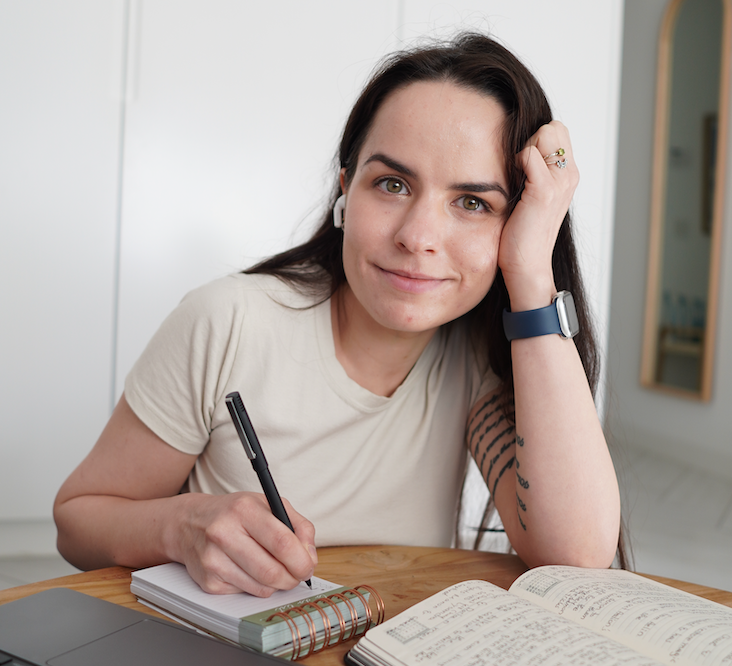
All photos courtesy of ADHD Coach Antonia. You can learn more about her and her practice, ADHD University, here. You can join the first body doubling session for free at this link: https://adhd-university.com/body-doubling/. Watch Antonia’s videos on YouTube under her creator name, @AntoniasUniverse.