
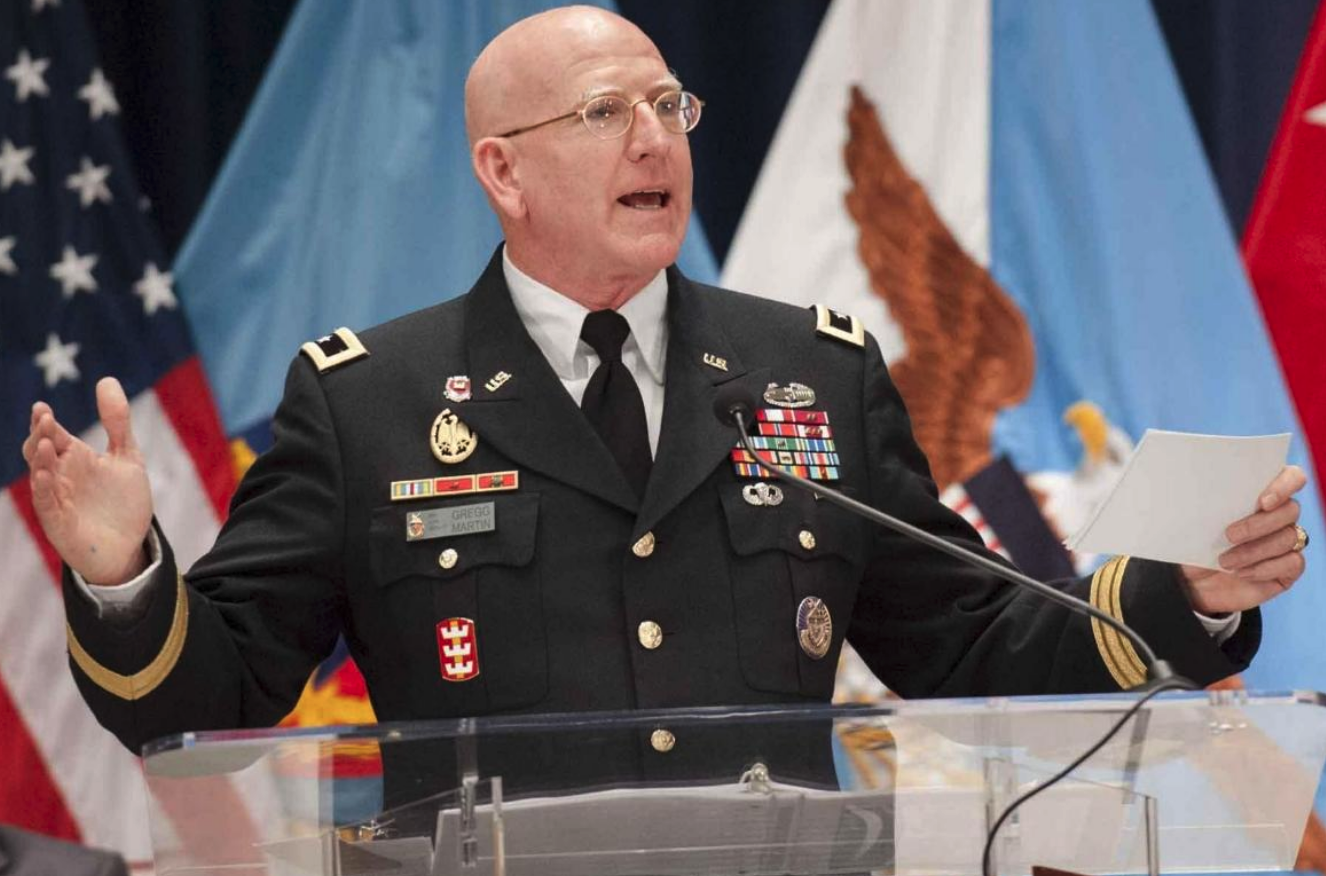
Part of The Deep Dive, a series of interviews with people on work, life and mental health. A conversation with 36-year combat veteran and author of book Bipolar General, Major General Gregg Martin, Ph.D, on leadership, mission, and mental health advocacy.
Content note: This conversation includes discussion of suicidal thoughts, psychosis, and the moral injury of war. Read at your own pace, and if you’re struggling, you can call or text 988 (the Suicide & Crisis Lifeline in the U.S.) any time.
I had seen General Gregg Martin speak several times before we actually met personally. He and his wife, Maggie, gave fascinating fireside chats through the Depression and Bipolar Support Alliance (DBSA) and the International Bipolar Foundation. Gregg’s candor, insight and inspiring story was captivating, and taught me so much. (I also had the honor of hosting my own fireside chat with him for DBSA California, which you can watch here.)
So when I got a LinkedIn message from him one day asking to connect with me after commenting on a post about bipolar advocacy, I was truly honored!
Gregg is undeniably a remarkable person. He had a very successful 36-year career in the U.S. Army, eventually rising to Major General. He has a Ph.D and two Master's degrees from MIT, as well as additional Master's degrees from both the Army and Naval war colleges.
He also lives with bipolar disorder, and has been candid about his experiences with mania, psychosis, depression and PTSD. He has created a second career as a mental health advocate, with a mission and purpose in sharing his bipolar story to help stop stigma, promote recovery, and save lives. He shares his story in his book, Bipolar General: My Forever War with Mental Illness, and in the 2025 documentary film Brainstorm.
Gregg is an incredibly kind and genuine person, and an enthusiastic advocate for mental health. He demonstrates a leadership style that I learned in my doctoral program: authentic leadership. A values-driven, mission-oriented leadership style where leaders align their external actions with their internal values and beliefs to build deep trust and meaningful relationships with their teams, it’s comprised of four main components: self-awareness, accountability, humility, and a growth mindset. They strive to build supportive environments where people feel seen, understood and trusted. In turn, they often inspire trust in return from their teams, because they feel supported.
Authentic leadership has always resonated with me. I’ve seen those traits reflected in the best supervisors and leaders I’ve had. And it’s a style that I have striven to embody in my own work — in fact, it’s a key part of my own mission and vision for Career Wavelength.
In my mind, you won’t find a better example of authentic leadership than in my “bipolar battle buddy” Gregg.
But I’ll let Gregg take it from here. I hope you enjoy this conversation as much as I did.
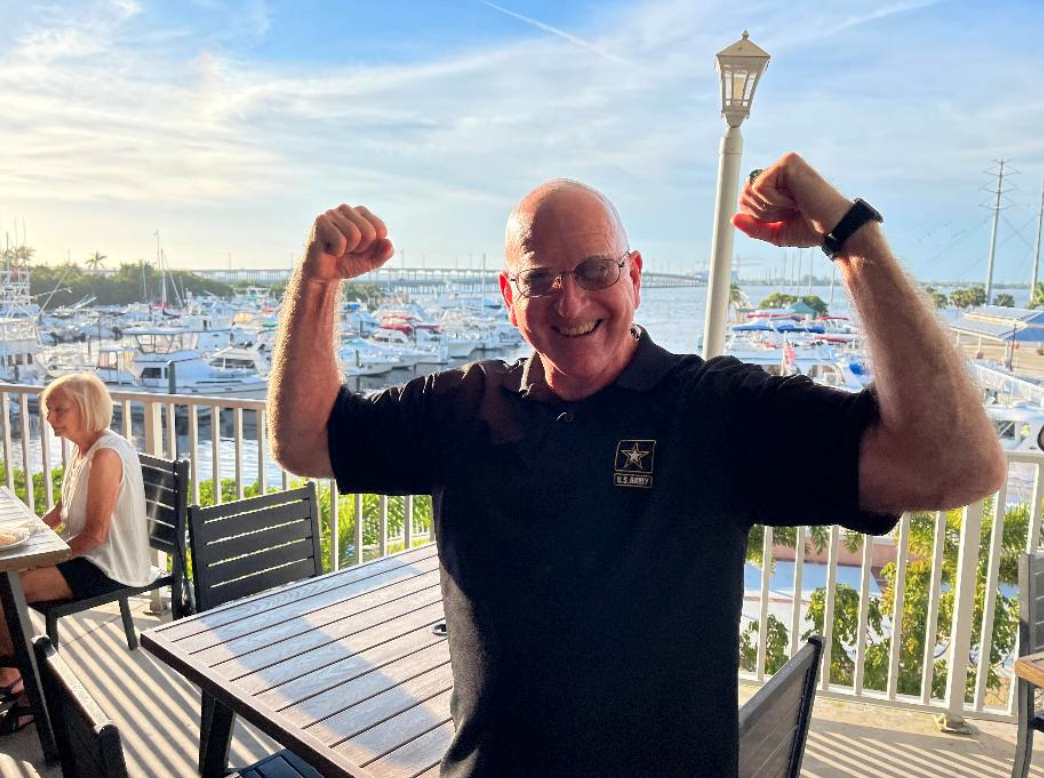
Tell me a little about yourself - who are you, and how do you describe what you do?
First thing, I'm a person. Just a human. I'm grateful that I'm a husband, I'm married, I'm a father. I had this really awesome career as an Army officer and leader that led to me making general, which is a huge part of my life and continues to be, even though I'm retired.
The other piece I'd add is that I live with bipolar disorder. It's an amazing, kind of mixed blessing. It helped me for most of my life, being on the low end of that bipolar spectrum. But then it went too high, and it took the success I'd achieved and pretty much blew it up — full-blown mania, psychosis, [and a] crash into depression.
The good news is I've made a really strong comeback the last ten years, and I'm back to my pre-crisis personality of hyperthymia — continuous mild mania. I'm living a wonderful life as a mental health advocate, helping, giving hope, teaching, leading, and inspiring people to be the best they can be.
I'd seen you speak quite a few times before we met, and you're the one who actually taught me about hyperthymia. How would you describe what hyperthymia is?
Most people have never heard of it — even many psychiatrists and mental health professionals haven't. The reason is it's not in the DSM, and it's not taught in most medical schools. It was a concept that was well understood, taught, and put into practice for about a century, until around 1980, when the DSM changed. The philosophy at the time was that the people running the show at the APA were cautious about over-medicalizing these personality types so they took it out, except for cyclothymia, which is still in there.
If you look at the bipolar spectrum, there’s a whole range of conditions along it. But underlying it are these mood types, which are actually a low-level form of bipolar disorder.
Hyperthymia, for me, is my base — a near-continuous, low-level mania. Dysthymia is the opposite: a near-continuous, low-level depression. Cyclothymia is a near-continuous cycling of the bipolar condition, at a more modest level. Euthymia is steady-state.
I'd never heard of it until I was writing my book and doing research. I read this magnificent book by Professor Nassir Ghaemi called A First-Rate Madness: Uncovering the Links Between Leadership and Mental Illness. He has sections on bipolar disorder and then on hyperthymia, and I thought — okay, I understand bipolar, I can relate, but what's this hyperthymia thing? Then I read the case studies he analyzed, and I thought, oh my goodness, that's me. That described my personality perfectly.
[Some] experts describe having hyperthymia as winning the jackpot, and that's really true. But Ghaemi puts a note of caution on it: [it’s] still on the bipolar spectrum, and depending on environmental circumstances and the course of [the person’s] own illness, it can easily escalate into higher and higher levels.
You've had a remarkably high-achieving military career — 36 years in uniform, rising to Major General. Could you share a little about your career journey?
I always knew I wanted to go into the military at some point. My dad was a World War II vet, and a lot of my family had served, so that was kind of a given. My mom pushed me toward one of the service academies — great schools, a full scholarship, a guaranteed job when you got out. I applied to all of them and was disqualified from every one except West Point, because of my eyesight. West Point was actually my last choice, because the Vietnam War had just ended and the Army was in a bad state of morale from that long, miserable war. I thought about it, prayed about it, and my mom pushed me — so I went.
I was in great shape, I was smart, I had all the qualities they wanted — but the first month was miserable. I thought the leadership was unprofessional, immature, [and] kind of hazing. It's one thing to be tough and demanding, but not petty and mean-spirited. I was ready to quit. I talked to some active-duty officers serving as counselors, and when I told them why I wanted to leave, they said this was kind of the West Point tradition, but out in the actual Army it wasn't like that — much more positive leadership, [and more about] taking care of your troops. So I went back, did a huge attitude adjustment, and let my hyperthymic personality — the positive energy, the drive, the enthusiasm — take over. For the next four years I excelled at West Point: student, athlete, leader.
Then I figured I owed five years back for the scholarship, so my plan was: go out, do the best I can, have a great attitude, take care of the troops — but when the five years are up, I'm done. I am not going to be a career guy.
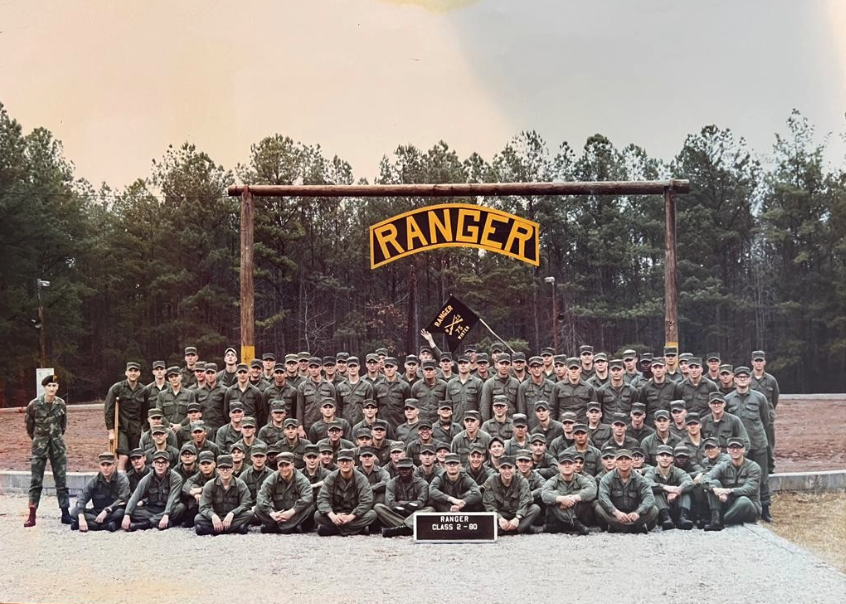
What changed it was getting out into the real Army, away from the strict rules and spit-and-polish of West Point. It was hard. In my platoon of 30 soldiers, about half a dozen who were convicted felons [who were] let out of jail to join up, because the Army couldn't meet its recruiting goals once the draft ended. The mission was intense — this was the Cold War, with the Soviet Union right across the border in East Germany. Dangerous times, a real mission leading my troops. I thought: it's dirty, it's hard, it's rough, there are real problems — and I can make a huge difference in the lives of these soldiers, many of whom weren't even high school graduates.
I trained the troops hard, we worked hard on maintenance and logistics — but a huge amount of my time as a lieutenant went into getting to know the soldiers, finding out about their goals, helping them put a plan together — whether that meant getting out of the Army to go to college, or building a career. A lot of them had personal problems too: pay issues, promotions that didn't come through, family trouble at home. I saw it as my job to understand these guys and help them be healthy, happy, [and] productive.
I went from wanting to get out of the Army to falling in love with it. Along with the job and the troops came traveling in Europe, meeting people, having a blast. And when you do well as an officer, they identify you early and send you to graduate school. The Army sent me to MIT, and my career took off. The longer I stayed, the more my natural personality — the hyperthymia, the extroversion, a kind of creative mind — just blossomed. I rode that wave all the way to two-star general.
Do you have a leadership philosophy?
Leadership comes down to two things: people and mission — plus clear communication about the vision and purpose.
On the people side, the most important thing is to understand and get to know your people: who they are, what motivates them, [and] what they want to become. That changes with the size of the organization. As a platoon leader with 30 soldiers, I [was able to] get to know every single one — a one-on-one, a cup of coffee — and say: I want to know everything about you. Who are you? What are your life priorities? I'd give them that as homework, and then we'd sit down and talk. We'd build a short, medium, and long-term plan — and sometimes that long-term plan was leaving the Army for college.
The troops knew I cared, that I'd taken the time to get to know them — so they were extra motivated. They worked harder because they wanted to improve. I carried that same principle all the way up to two-star general. At Fort Leonard Wood, I had about 30,000 people — military, civilian, international — but with my direct reports, I did essentially the same thing.
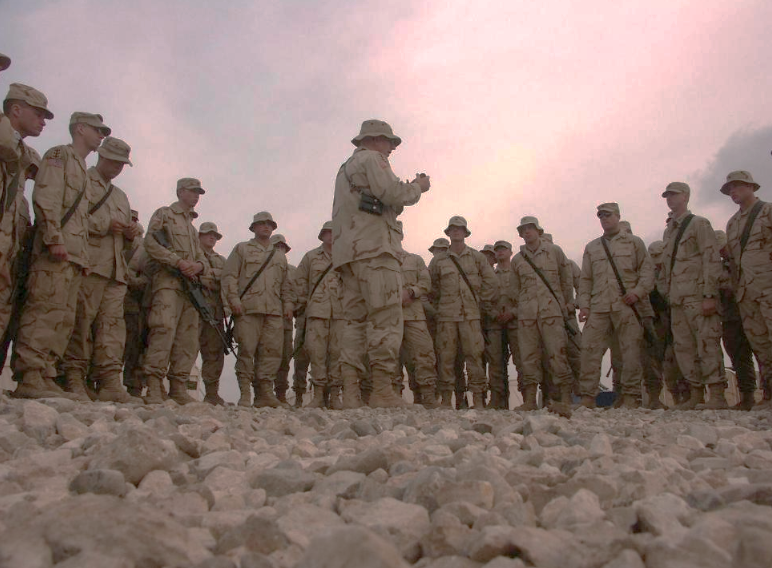
One technique I started was book clubs — enlisted soldiers or senior leaders alike, reading something together and discussing in a small group. Another was one-on-one physical training: I'd set a time, just the two of us, you setting the pace. During the run, I'd ask you to tell me your life story, your goals, what you were hoping to get out of the assignment. Afterward we'd go have breakfast, and I'd give you my read, based on what you'd told me. A month or so later, we'd do a book review — your pick — and you'd invite whoever you wanted and lead the discussion. That paid huge dividends over the years.
Then there's the mission — the whole reason an organization exists. I think it's important for the leader and everyone around them to get really clear, and get buy-in, on the vision — where do we want to go, what are our values? Out of that comes a purpose, and a clear, focused mission statement. I think about the mission almost mechanically: the five W's, then how. Who, what, why, when, where, how — and then focusing relentlessly on achieving it while taking care of people.
And then — take a breath, pause — not being so mission-focused that you live an unbalanced life. Build in the things that give you balance and make your life fun.
As the demands of your career escalated toward higher command, what do you first remember being the earliest signs you were shifting from your baseline hyperthymic personality to something higher?
All of this is looking in the rearview mirror — really, in the last twelve years since my diagnosis. I was cruising along in a state of happy, productive hyperthymia for years, from junior high and high school on. Looking back now, I realize my life began to change in my early forties. I think it was two things: the natural course of the bipolar disorder starting to get more active, and — maybe because of the environmental factor of this ratcheting pressure and responsibility — I started going…into more noticeable spikes to higher levels. Not yet fully manic by DSM-5 standards, but clearly higher — impulsivity, recklessness, energy, less sleep.
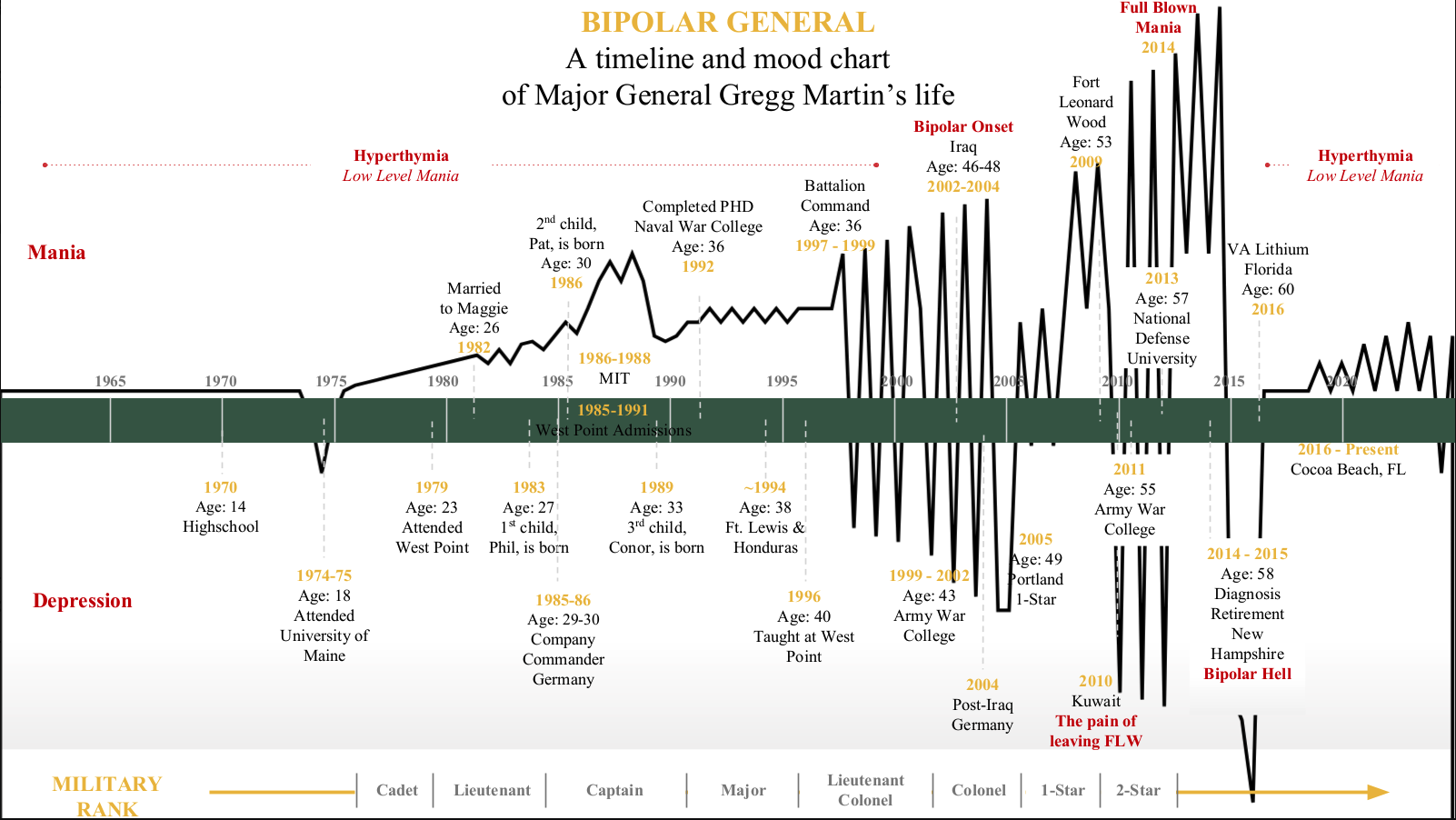
What surprised me, looking back, is that I also started diving into depressions on a fairly regular basis — sometimes once a week, sometimes every day, but short. I remember thinking: why do I have this sick feeling in the pit of my stomach? Why don't I want to get out of bed? I also had a toxic boss around that time — he demoralized everybody around him. But I was able to amp myself up — I learned how to take the hyperthymia and elevate it into higher levels that made me happy again. I could almost talk myself into it, or pray myself into it, or exercise, or listen to really exciting music. What's interesting is that through all of it, my performance was really high — I kept getting promoted, bigger and more prestigious jobs.
Then came the Iraq War. There were two pieces to it — the preparing, training, deploying, and fighting was super intense, and the VA and Army Medical Department have since assessed that the intensity spiked me to a higher level. At first that was this incredibly exuberant, high-performing mania — it [felt] like being on the best drugs in the world with no downside. Until — and this is something I've only recently [realized] — I suffered a terrible moral injury in that war. Key strategic decisions made at the highest levels of government — decisions the senior military leadership had predicted would turn the population against us, like disbanding the Iraqi army and de-Ba’athifying the society — were made anyway, against the best military advice. And sure enough, we went from liberator to occupier, engulfed in a guerrilla war with suicide bombers and IEDs. The attack on Baghdad itself took 18 days and we lost fewer than 100 U.S. troops, which is remarkable — but once the guerrilla war triggered, it went on almost a decade, and we lost tens of thousands killed and wounded, with hundreds of thousands of Iraqis killed.
Being part of that — seeing those decisions, being part of the death and destruction — it ripped a hole in my soul. That's a moral injury, and I felt terribly betrayed by our political authorities, and then had to experience the result in blood on the battlefield. My mania, instead of being euphoric and happy, turned into rage, anger, fury. Thankfully I was able to keep it together and still be an effective commander. But it sent me off the charts.
When I got back from Iraq, I had a big depression for almost a year, and then started cycling back into manias that were, for the most part, high-performing — they tended to serve me pretty well until they got too high. But over that twelve-year stretch, the depression got more and more significant.
I came home, fell into a horrible depression, and — still with no diagnosis, no idea what was happening — spent the next twelve years cycling into higher and higher manias and deeper depressions as the moral injury ratcheted everything up. Then PTSD kicked in, and I finally blew into full-blown mania in 2014, where I was fired from my job, forced to retire, ordered to get a psychiatric evaluation, and hospitalized. All of that together finally brought me from full-blown mania to a really deathly depression, psychosis, [and] suicidality.
Three different times, between getting back from Iraq and the full-blown mania, I went to doctors and said, I'm depressed, something's going on. Every time, they checked me out and said I was fine — because they were blinded by my success. They looked at me and just saw success: a colonel, a general, an MIT grad. They couldn't see it. It wasn't until my seventh visit that a doctor finally recognized the depression. But they still wouldn't have diagnosed bipolar disorder if my wife, Maggie, hadn't come to that seventh appointment. She told the doctor: I agree, he's depressed now, but in the past he's been manic. When the doctor asked her to describe what she meant, she could have just read straight from the DSM-5 — I had all the symptoms. The lights went on, and he said: bipolar disorder, Type 1, with psychosis.
The miracle for me was lithium. Once I started taking it ten years ago, the depression went away, the psychosis went away, the suicidality went away. It was a long journey to a correct diagnosis, but I'm grateful they got it right in the end. I got my life back — I've gone from death to life, and I have this wonderful new purpose, and I'm loving it.
You created this whole second career as a mental health advocate. What led you to want to share your story so openly?
After the full-blown mania and getting fired, I had about two years of terrible depression where I wanted to die every day. When I finally got on lithium and started getting my life back, the early recovery was just about my own health — sleep, working out, eating well, spending time with Maggie, getting our relationship back on track. We moved to Florida for the sunshine, got back into social activities, back into faith and church life. I was moving in the right direction for a year or two — and then I had this gnawing feeling: what am I doing with my life? What am I doing that makes a difference for anybody? In the Army, I'd had that purpose and mission every single day. I didn't have anything like that anymore.
So I started saying, I need a mission, a purpose, a vision for my life. I read about the process, talked to mentors, and prayed about it — [God], you saved me from suicide, from dying, kept me alive when it could easily have gone the other way, so what do you want me to do with my life? Over days and weeks, the answer came back: you already have your purpose. You've gone through this terrible crisis, hit rock bottom, and you're on the way up — you've gone from darkness to light. There are a lot of people going through what you've been through. Go tell your story, be a light, help other people by sharing what you've learned. It was like — I've given you the personality, the intelligence, the communication skills, you know how to write, you know how to speak, you like people. Now, instead of Army stuff, go do bipolar and mental health stuff. That's your mission. Go tell your story.

You're such a great example that this condition doesn’t have to limit what someone can achieve. How has that shaped your career since leaving the Army?
It's interesting — there were two really viable tracks for my post-Army career, both of which I was well qualified for: construction engineering, since my branch was engineers, and education, since I'd run a number of Army educational institutions. I was tracking toward that, with people telling me they'd hire me when I retired — and then the bipolar crisis blew everything up.
When I got healthy enough to re-engage, I was nominated for some good jobs, including a university presidency. I love education, so I said, let's do this. I made it to the final three — and then withdrew. The reason was, during the interview process, talking through my leadership experience, I could feel my mood spinning, inching from hyperthymia to something higher, and I knew what was happening. I talked to my psychiatrist, my therapist, had a long talk with Maggie, and realized: if I get hired and become a university president, I'm throwing myself right back into a pressure cooker — budgets, politics, culture, all of it. I thought about it, prayed about it, and concluded: your ego is taking you in this direction, and this isn't healthy. So I told them, I'm going to withdraw, [and] here’s why — [I have] bipolar, [and I] don't want to go there. It was a great decision, because it let me take that same energy and passion and experience, and do it at my own pace, as fun or as intense as I want, instead of being a university president or a corporate executive.
The bipolar — I respect it enormously. I know what it did to me, both good and bad, and what it can still do if I'm not smart and vigilant. So I deal with it in a way that's realistic and respectful, but I want to keep it under control. I don't want it to take over my life again.
You built a life and career around managing this well. For someone trying to figure out how hard to push in their own career while managing a mood disorder, what would you tell them?
First — if a person thinks they may have a mental health condition, or people around them see something of concern, go get assessed by a professional. They may say there's nothing there, but if there is an issue, better to know earlier than later.
If you are diagnosed, accept it. Don't fight it, don't go into denial — there's nothing wrong with a second opinion, but in my experience, mental health professionals tend to under-diagnose these conditions, not over-diagnose them. Accept it, embrace it as part of you, then learn everything you can about it — books, articles, podcasts, conferences. Then, with your team — medical professionals, spouse, family — build a strategy to be healthy. For me: [I] work with a psychiatrist, take my meds, work with a therapist I find invaluable, live a healthy life [with good] sleep, low stress, water, exercise.
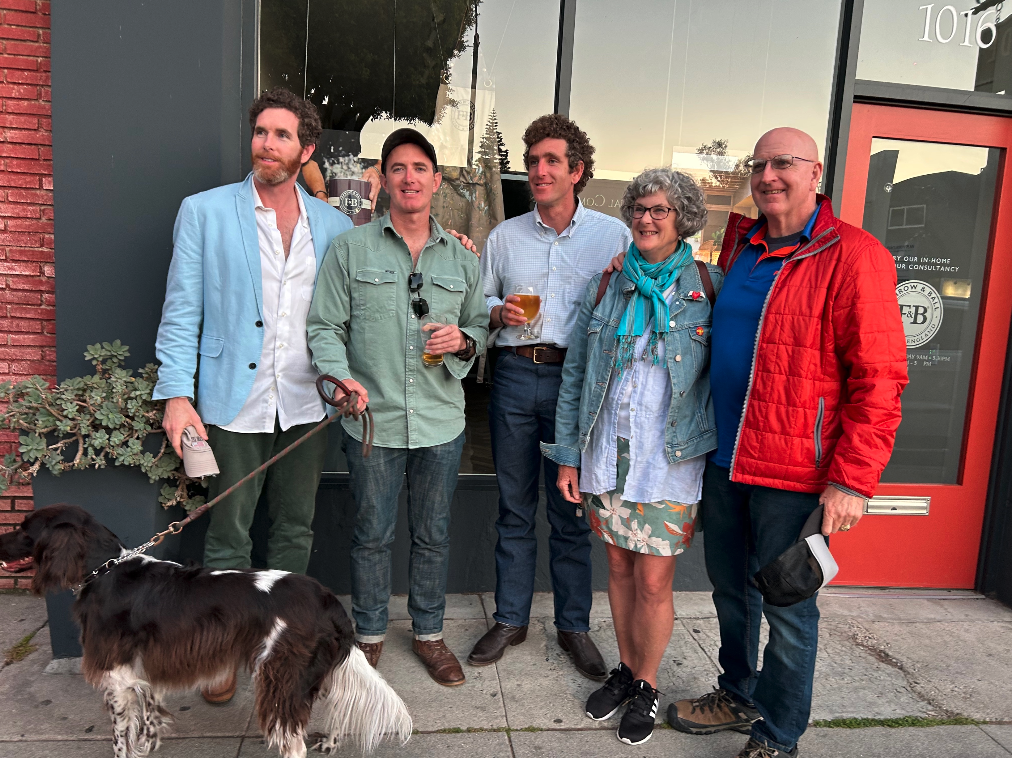
And then I've come up with this construct I call the five P’s:
Purpose — define it and live it.
People — be around people every day who energize you.
Place — if you have the means, live somewhere that's healthy for you; if you're a passionate skier, think about Utah, if you need sun and surf, Florida or Southern California.
Perseverance — just don't quit, keep working. And perspective — watch your own thinking, because we can sabotage ourselves with negativity. With bipolar, it's easy to think "my life is over" — it's not. You can understand it, manage it, live a fabulous life. And there are people who have it worse — cancer, heart disease, other conditions that are even tougher to live with.
Then you need a battle Plan — day to day, week to week. I'm an Army guy, so [for me it’s]: wake at 6am, spiritual grounding time, breakfast, a bike ride or the gym, a structured series of events across work, play, and family, meals at predictable times, dedicated time with your spouse, wind down at 9, lights out at 10, eight hours of sleep, up at 6 the next morning. Having that structured life is really key.
I also think it's important, every day, to think about how much you have to be grateful for — I keep a gratefulness journal and write it down, thank God or the universe or whatever [you believe in]. Having that ever-present attitude of gratitude, no matter what, is important.
But the reality is, I have bipolar disorder, and I'm going to have rough patches. I still do — less frequent than they used to be, but every few months I'll have a period of some level of depression. Luckily it's not horrible, and it doesn't last long, usually a few days. I'll also have spin-ups into higher mania — if it's happy, euphoric mania, that's not so bad, I'm productive, but it can go irritable and mean-spirited too. So I have to have the knowledge and the techniques to block the depression and pull myself out of it — mostly learned from my therapist — and to dampen and slow down the rises in mania.
That's my advice: live your life to the fullest, be happy, go for it every day.
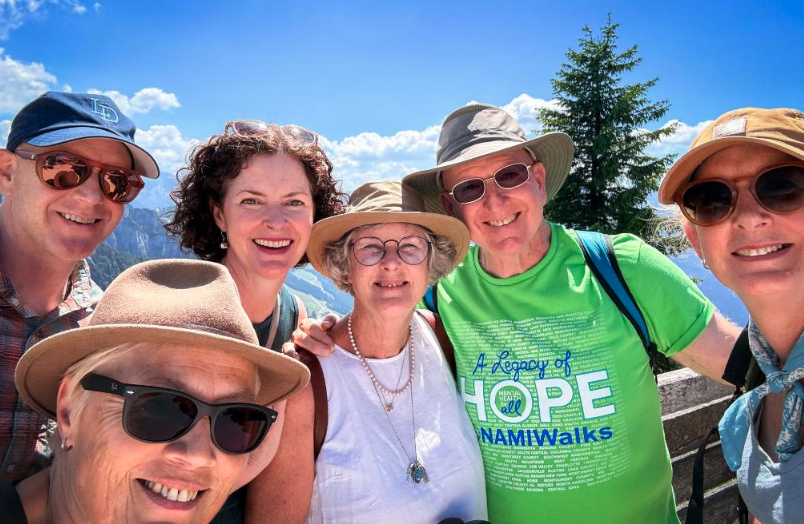
All photos courtesy of Gregg Martin. You can find out more about General Gregg Martin at www.bipolargeneral.com, where you can also purchase his book, Bipolar General: My Forever War with Mental Illness. Gregg is also featured in the documentary film Brainstorm, which will be coming to PBS soon; you can learn more about the film here.